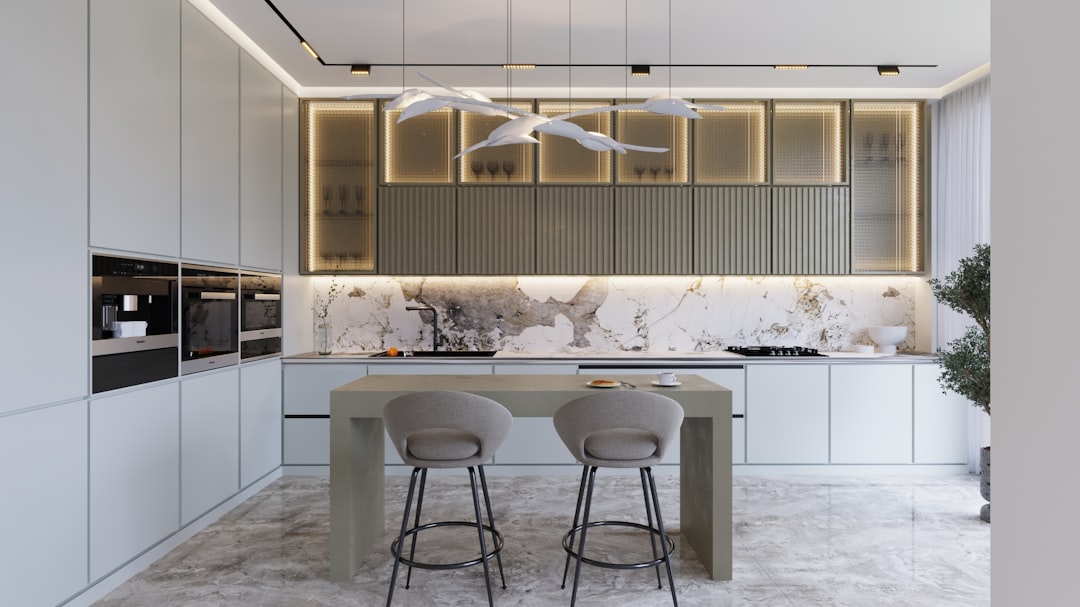
Kitchens are where renovation budgets go to get optimistic. The category has a reputation for strong returns, which means homeowners pour money into changes that feel like improvements but land flat with buyers — or worse, actually narrow the pool of people who want the house. Not every update that was exciting in 2012 or 2016 reads as an asset today, and a few of them have crossed from “neutral” to “this will need to come out.”
Here are nine kitchen trends that show up regularly in pre-sale renovations but consistently fail to earn back their cost — along with what to do instead if you’re deciding whether to spend now or wait.
The Trend List: Nine That Aren’t Pulling Their Weight
1. Granite Countertops with Heavy Figuring
Granite had a long run as the premium countertop default. The problem now isn’t the material — it’s a specific look: large, dramatic veining in browns, golds, and burgundies, often paired with a beveled ogee edge. Buyers in the current market lean toward quieter surfaces, and that swirling Santa Cecilia or Venetian Gold pattern reads as something to replace rather than enjoy. If your granite is relatively neutral in color and matte-finished, you’re probably fine. If it’s a showpiece slab from 2008, manage your expectations about what it adds.
2. Tuscan and Old-World Styling
Wrought-iron pot racks, travertine floors, distressed cabinet finishes, stone-look tile with dark grout — the entire Mediterranean farmhouse vocabulary that dominated the mid-2000s now signals “hasn’t been touched.” The problem is that this aesthetic requires full commitment to reverse. Painting cabinets helps partially, but the travertine floor and the arched range hood are structural commitments. If you’re pre-sale and you have this kitchen, prioritize decluttering and lighting before spending money on cosmetic counters — buyers will discount the kitchen anyway, and competing with that assumption through half-measures rarely works.
3. Matching Appliance Suites with Ornate Handles
A full matching set in a single finish sounds cohesive. In practice, the matching look — particularly brushed brass or ornate bar-pull appliances — dates a kitchen the same way a matching bedroom “suite” in cherry wood does. Integrated or panel-front appliances read as intentional. Matching decorative handles on every visible appliance door read as a 2015 showroom.
4. Wine Fridges Built Into Every Available Corner
Undercounter wine refrigeration became the go-to “luxury touch” for a stretch of kitchen renovations, particularly in the $300K–$600K renovation tier. A single, well-placed wine fridge in a kitchen island is still a reasonable amenity. Three of them — one under the counter, one in the butler’s pantry stub, one near the dining room entrance — signals over-customization for a specific lifestyle. Buyers who don’t drink wine see awkward appliance cutouts. Buyers who do usually want them positioned differently than you placed yours.
5. Dark Espresso Cabinets
This is a trend that aged faster than almost any other in the kitchen category. Espresso stained cabinetry — heavy, flat-fronted, with brushed-nickel bar pulls — hit a saturation point in new construction between roughly 2009 and 2016, and it’s now the renovation detail most commonly cited in buyer feedback as a reason to request a price reduction. The irony is that dark cabinets done intentionally and well — navy, deep forest green, even black in the right space — read as contemporary. Espresso stain reads as dated builder-grade. There’s a meaningful difference, and buyers feel it immediately. A strategic repaint can close much of the gap without a full cabinet replacement; the difference dark paint makes is worth understanding before you write off the cabinets entirely.
6. Decorative Range Hood Surrounds with Elaborate Millwork
The range hood surround became a focal-point opportunity, and then it became a competition. Built-up crown molding, corbels, carved wood details, painted wood panels flanking the hood on both sides — the effect was “kitchen as architectural statement.” Today’s buyer preference runs toward cleaner integration or statement hoods that are sculptural in form, not millwork-heavy. If you’re renovating before sale, an ornate hood surround is rarely worth preserving as-is, and rarely worth the cost to replace before listing either. It’s a wash that often pushes buyers toward “we’d redo the kitchen anyway.”
7. Ceramic Tile Backsplashes in Busy Patterns
Backsplashes are a known high-visibility, relatively low-cost upgrade — which is exactly why so many sellers install them wrong. A busy, Tuscan-style ceramic tile in terracotta and cream, a hand-painted talavera-style pattern, or a multicolor mosaic that was meant to tie together the rest of the kitchen’s colors now reads as personalization that the buyer will spend money undoing. A clean subway tile, a simple brick pattern in white or off-white, or a large-format porcelain in a neutral tone adds value consistently. If you’re wondering what a backsplash upgrade actually costs to do reasonably well, a builder-grade kitchen backsplash project illustrates what’s achievable without overcorrecting into maximalism.
8. Pot-Filler Faucets Over the Range
Pot fillers were a symbol of a serious kitchen for a specific era. They’ve crossed into the category of amenities that communicate “this kitchen was renovated by someone who watched a lot of HGTV in 2014.” That’s not a fatal flaw — but it’s a neutral-to-negative feature for most buyers, who either see a leaky risk (they have a reputation for valve failures over time) or simply don’t use them. If you have one and it works, leave it. Don’t add one to a pre-sale renovation budget in 2025.
9. Open Shelving as the Primary Storage Solution
Open shelving got a long moment in the spotlight, promoted as a way to make kitchens feel larger and more editorial. In practice, it requires constant curation to look good, shows grease accumulation faster than closed cabinetry, and reads as reduced storage in buyer walk-throughs — not a design choice. A single run of open shelving alongside closed cabinets still works. A kitchen where open shelving replaced most upper cabinets is a harder sell than it was five years ago. Buyers tend to mentally reprice it to include restoring the storage.
What Actually Moves the Needle Instead
Before committing budget to any of the above — or to reversing them — do a calibrated assessment of what’s actually affecting the kitchen’s value versus what just looks tired. In many cases, the higher-leverage moves are:
- Deep cleaning and degreasing, which costs almost nothing and removes years of visual age from any surface
- Hardware swaps — pulling ornate or mismatched handles and replacing with a single, simple profile in a consistent finish
- Lighting updates, particularly if the kitchen still runs on a single ceiling can or a builder-grade fluorescent strip. The difference between flat, undirected light and layered task and ambient lighting is significant in how a kitchen photographs and how it feels to stand in
- Appliance refresh at the surface level — fingerprint-resistant film over stainless, or simply ensuring appliances are polished and functioning quietly during showings
If the kitchen needs a more substantial intervention and you’re trying to understand whether the numbers make sense before committing to a contractor scope, running the projected cost against potential resale value — using whatever local comparable data you have access to, not a national average — is the correct sequence. Our renovation cost planning tools can help frame the financing side of that decision, but the local comp research comes first.
The Practical Next Step
Before scheduling a single contractor estimate, photograph every surface in your kitchen under natural light with no staging — the way a buyer sees it on a Tuesday afternoon. Then compare what you see against the nine categories above. If three or more apply to your space, the problem is probably not individual features but the overall vocabulary of the room, which usually responds better to a focused reset (paint, hardware, lighting, and a backsplash swap) than to swapping individual dated elements one at a time. Get at least two contractor quotes scoped around that narrower set of interventions before authorizing anything broader — the total numbers often tell a clearer story than the trend lists do.