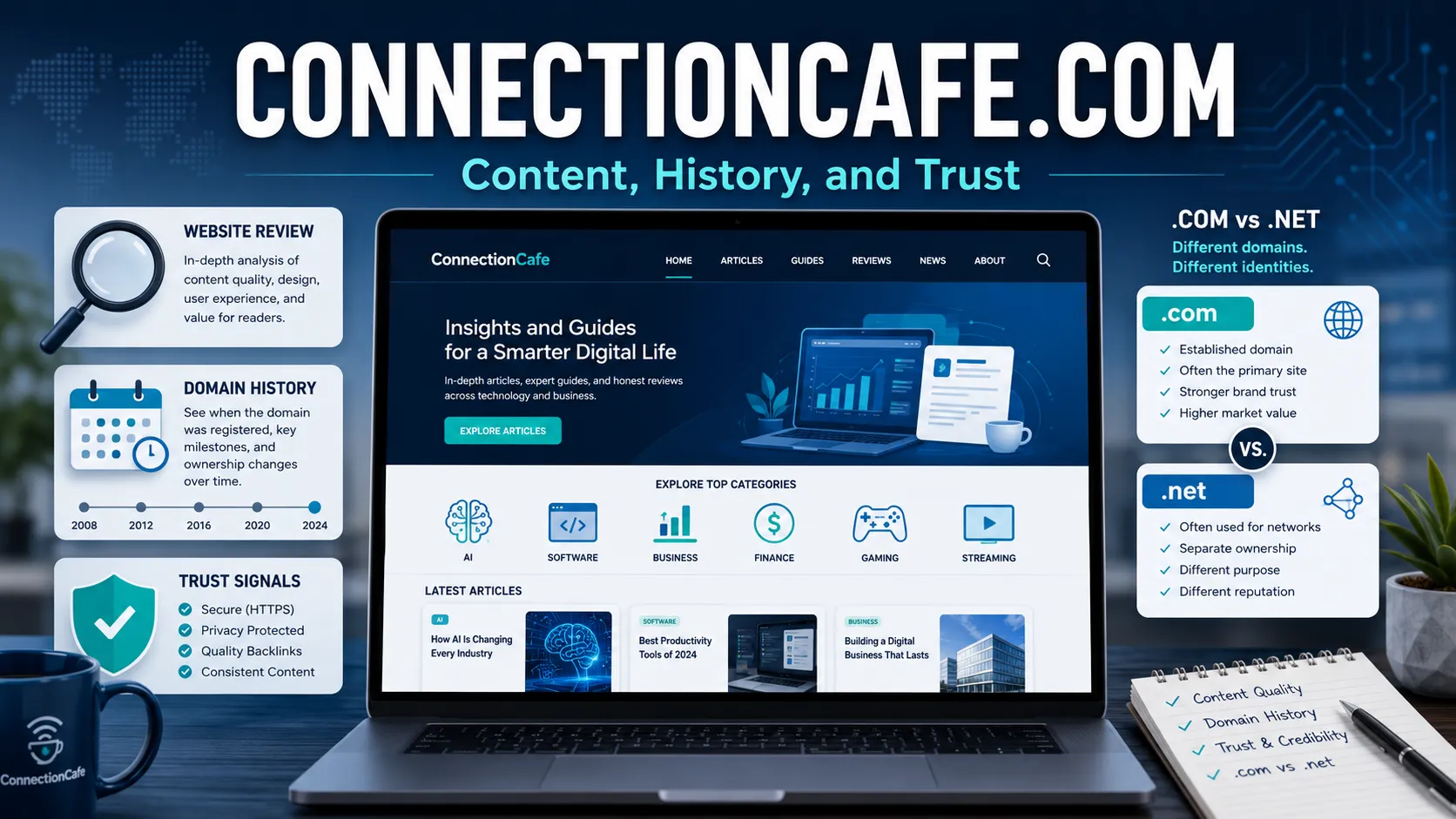
ConnectionCafe.com is an active technology and digital media website that publishes software guides, troubleshooting articles, business content, product-focused features, and material about AI, finance, gaming, streaming, and other online services. New articles were appearing on the site in July 2026.
The site has recognizable features of an operating publication, including an article archive, author pages, contact information, an About page, and a contributor section. Those signals establish that the website is active, but they do not prove that every article follows the same editorial process or provides equally reliable advice. The domain’s long history, contributor model, broad subject range, and inconsistent sourcing make article-level evaluation especially important.
What Is ConnectionCafe.com Today?
ConnectionCafe.com currently operates as a broad technology and digital information blog. Its published material includes tutorials, product comparisons, recommendations, news, error guides, and explanations of online tools and platforms.
The site describes itself as a technology blog offering news, educational articles, practical guides, recommendations, and reviews. Its navigation supports that description but also shows that the editorial scope is wider than traditional consumer technology. Current categories include AI, software, apps, business, finance, cryptocurrency, gaming, streaming, torrent sites, and technical error guides.
Connection Cafe is therefore a publisher rather than an official software provider, financial institution, security company, or customer-support service. Its articles may help readers understand a product or identify possible solutions, but they do not replace documentation from the company responsible for that product.
That distinction becomes more important when a topic involves payments, account access, cybersecurity, cryptocurrency, gambling, privacy, streaming rights, or software downloads. A general article can provide useful orientation, while the final decision should rely on current primary sources.
Why the Domain’s History Needs Context
The ConnectionCafe.com domain was registered on April 18, 2001. That makes the domain considerably older than the current version of the technology blog, but the registration date should not be presented as the founding date of today’s publication.
A domain can change ownership, hosting, subject matter, and commercial purpose. It may also remain inactive or be rebuilt after an earlier project ends. For that reason, the age of a domain and the age of its current editorial operation are separate facts.
Older references from the late 2000s and early 2010s associated Connection Cafe with nonprofit technology, digital analytics, fundraising, and Convio-related material. The present site has a substantially different content profile, covering consumer software, AI, gaming, entertainment platforms, business services, and general internet guides.
This historical difference suggests that the domain has not always served the same editorial purpose. Publicly available information does not establish a complete chain of ownership or prove when the current publishing team took control.
The current About page also states that the site has produced more than 1,000 articles over approximately seven years. That is a claim made by the website itself. It may describe the current project’s archive, but it does not establish uninterrupted editorial activity since 2001.
What the Crunchbase Profile Establishes
A Crunchbase organization page exists for ConnectionCafe.com, but its complete contents and relationship to the current technology blog could not be verified during research.
It would therefore be misleading to use the profile as proof of the present site’s founding date, ownership, headquarters, employees, or corporate history. Third-party business databases may preserve information about an earlier organization that once used the same domain.
Unless the profile can be connected to the current blog through archived pages, official statements, matching legal entities, or documented ownership records, it should be treated as an unconfirmed historical lead rather than evidence about the present publication.
ConnectionCafe.com and ConnectionCafe.net Are Different Domains
ConnectionCafe.com and ConnectionCafe.net are separate domains with different registration histories, infrastructure, content, and automated reputation reports.
This distinction matters because the supplied Gridinsoft page for connectioncafe.net does not evaluate the main website discussed in this article. The .net domain was registered on September 29, 2025, while the .com domain dates to April 18, 2001.
ConnectionCafe.net has published a page claiming that both addresses belong to the same platform. However, the .net site also describes profiles, chat, matchmaking, webinars, and other functions that are not visible on the current .com technology blog. The domains use different contact information and do not provide a clear, independently verifiable ownership statement connecting them.
The claim of a relationship may be true, but it has not been confirmed through registration records or a primary statement on ConnectionCafe.com. Readers should therefore avoid transferring reputation scores, security results, or business information from one domain to the other.
When checking any website, the complete address matters. A scanner result for .net says nothing conclusive about .com, even when the names look nearly identical.
What Topics Does Connection Cafe Publish?
Connection Cafe covers multiple categories with different levels of practical and reputational risk. Some material provides low-risk introductions or technical steps, while other articles address decisions involving money, privacy, account security, gambling, or copyrighted content.
The table groups the current coverage by reader need and shows what may require additional verification.
| Content group | Typical subjects | Common reader goal | Main verification concern |
|---|---|---|---|
| Technology, AI, and software | AI tools, apps, hardware, digital products, error fixes | Understand or compare a tool | Features, pricing, permissions, and update dates |
| Business and finance | Payments, business software, companies, capital, cryptocurrency | Evaluate a service or solve a business problem | Commercial claims, financial risk, and official terms |
| Gaming and entertainment | Games, skins, casinos, streaming, media platforms | Discover or access a service | Payments, licensing, account safety, and regional law |
| General internet guides | Websites, online accounts, mobile apps, access problems | Complete a task or troubleshoot an issue | Device versions, service changes, and current instructions |
The wide subject range can make the site useful for early research. A reader may discover a type of software, learn basic terminology, or find several possible fixes for an application error.
The level of caution should rise with the consequences of following the advice. Clearing an app cache is not comparable to identifying a suspicious bank charge, choosing a cryptocurrency service, using an online casino, or visiting an unofficial streaming mirror.
Who Writes the Articles?
Connection Cafe displays author names and maintains author archives, but the public information does not fully explain its publishing workflow.
A large portion of the archive appears under the byline Richard. The author page spans 219 archive pages and covers a very broad mix of topics, including AI, business, software, finance, travel, industrial equipment, gaming, and online casinos.
The page is located at /author/matt/ even though the displayed name is Richard. This may be a harmless content-management inconsistency caused by a renamed account, site migration, reused WordPress profile, or administrative oversight. The site does not publicly explain the mismatch.
The range and volume of material under one byline do not prove that every article was personally written by one individual. The account may represent an editor, a shared publishing profile, a migrated author record, or a workflow involving multiple contributors. That cannot be determined from the visible profile alone.
Connection Cafe also has a Write for Us page inviting external submissions. The published guidelines ask prospective contributors to propose a topic before submitting an article and describe an expected length of approximately 500 words. This confirms that at least part of the archive may come from outside contributors.
Several service pages, including About, Privacy Policy, Contact, and Write for Us, also contain links related to online casinos that do not closely match the primary purpose of those pages. Their presence is observable, but the cause is not established. They should not automatically be described as evidence of hacking, spam injection, paid links, or hidden advertising.
Readers should evaluate authorship using signals available on the individual page:
- whether a clear byline is present;
- whether the author profile shows relevant and verifiable experience;
- whether important claims link to primary sources;
- whether a contribution, sponsorship, or promotional relationship is disclosed;
- whether the article belongs to an account publishing across many unrelated subjects;
- whether the recommendation can be confirmed independently.
A byline makes a page less anonymous, but it does not establish expertise or editorial independence by itself.
Is ConnectionCafe.com Legit and Safe to Visit?
ConnectionCafe.com displays several signs of an operating content website. It has an active archive, recent publications, author pages, contact information, contributor guidelines, and functioning editorial pages.
These signals support the conclusion that the site currently operates as a real publication. They should not be confused with guarantees about technical safety, factual accuracy, ownership, or the quality of every external service mentioned in its articles.
The most common trust indicators each answer a limited question.
| Signal | What it shows | What it does not prove |
|---|---|---|
| Domain registered in 2001 | The original registration date | Continuous ownership or operation of the current blog |
| HTTPS connection | Data between the browser and site is encrypted | Accuracy of articles or safety of linked websites |
| Clean automated scan | No listed threat was detected during that scan | Permanent safety or absence of risky recommendations |
| Author byline | A name is associated with the page | Verified qualifications or independent judgment |
| Write for Us page | The site accepts outside contributions | Equal editorial review across all published articles |
Gridinsoft’s report for ConnectionCafe.com displayed an automated trust score of 79 out of 100 and zero warnings among 27 listed providers. However, the full scan shown on the page was dated November 8, 2025, and the service itself marked the result as older than 30 days.
That report can be treated as a historical technical signal, not a current certification. Automated scanners may detect malware, blacklist entries, certificate issues, hosting patterns, and other domain-level indicators. They do not assess whether a financial explanation is correct, a product recommendation is commercially motivated, or a streaming guide accurately explains legal risk.
The available evidence supports describing ConnectionCafe.com as an active and identifiable website. Whether a particular article is reliable remains a separate question.
How Reliable Are Its Articles?
A review of articles across several categories found that Connection Cafe’s sourcing and editorial caution vary substantially.
Some pages include useful explanations and links to official documents. For example, a product article about industrial cables referenced manufacturer information and other technical sources. Even there, the article also directed readers to a commercial seller, and not every comparative claim was independently supported.
Other articles were built primarily around one promoted service. An AI video tools feature emphasized a particular provider and made claims about capabilities, privacy, languages, and workflow benefits without consistently linking to independent evidence.
A business payments article included broad claims about conversion rates, approval rates, and operational savings without presenting supporting data. A small-business capital article gave percentage-based financial rules without identifying their source and also contained an unrelated gaming link.
A guide to an unfamiliar Apple billing charge recommended some reasonable actions, such as reviewing purchase history and contacting Apple or a bank. However, it did not link to official Apple documentation and treated the phone number in the transaction description as a standard Apple billing identifier without sufficient evidence.
The most serious concerns appeared in a PrimeWire article. It recommended VPNs, proxies, mirrors, and shortened links for accessing a streaming platform. It also implied that using a VPN could remove legal risk. A VPN may change how internet traffic is routed, but it does not make unlicensed access lawful or establish that a mirror is safe.
The reviewed articles were accessible without a required account or paywall. Clear sponsorship or contributor disclosure was not visible in the accessible text of several commercially focused pages. That does not prove those articles were paid placements, but it makes the commercial context harder to evaluate.
Before relying on an article, readers should check:
- Publication date: Confirm that software interfaces, prices, services, and policies are still current.
- Author context: Determine whether the profile demonstrates relevant experience with the subject.
- Primary evidence: Look for official documentation, regulatory records, original data, or direct company policies.
- Exact claims: Treat rankings, percentages, performance promises, and security guarantees cautiously when no methodology is provided.
- Commercial links: Identify whether the article consistently directs readers toward one provider or product.
- Consequences: Apply stricter standards when advice affects payments, passwords, personal data, legal rights, investments, or software installation.

A simple troubleshooting guide may still be useful when its steps are current, reversible, and clearly explained. Advice involving higher financial, technical, or legal risk requires confirmation from an official or specialist source.
When Connection Cafe Is Useful and When to Check Elsewhere
ConnectionCafe.com can help readers begin researching an unfamiliar tool, understand basic terminology, discover possible services, or find preliminary troubleshooting ideas. Its large archive makes it convenient for broad exploration.
The site is most useful when the cost of incomplete or outdated information is low. A reader might use an article to understand what a category of business software does or to identify several possible causes of a noncritical app error.
Primary sources should take priority when a decision concerns:
- bank accounts, payments, investments, or cryptocurrency;
- passwords, malware, account recovery, or personal information;
- online casinos and other age-restricted services;
- torrents, streaming rights, mirrors, or regional access restrictions;
- legal, medical, or regulated business questions;
- downloads from unfamiliar software providers.
The safest approach is to confirm that the article is on the correct domain, inspect its date and byline, check the evidence supporting its main claims, and look for signs of a commercial relationship. Connection Cafe may provide a useful starting point, but the age of its domain and a historical automated trust score do not make every article an authoritative source.