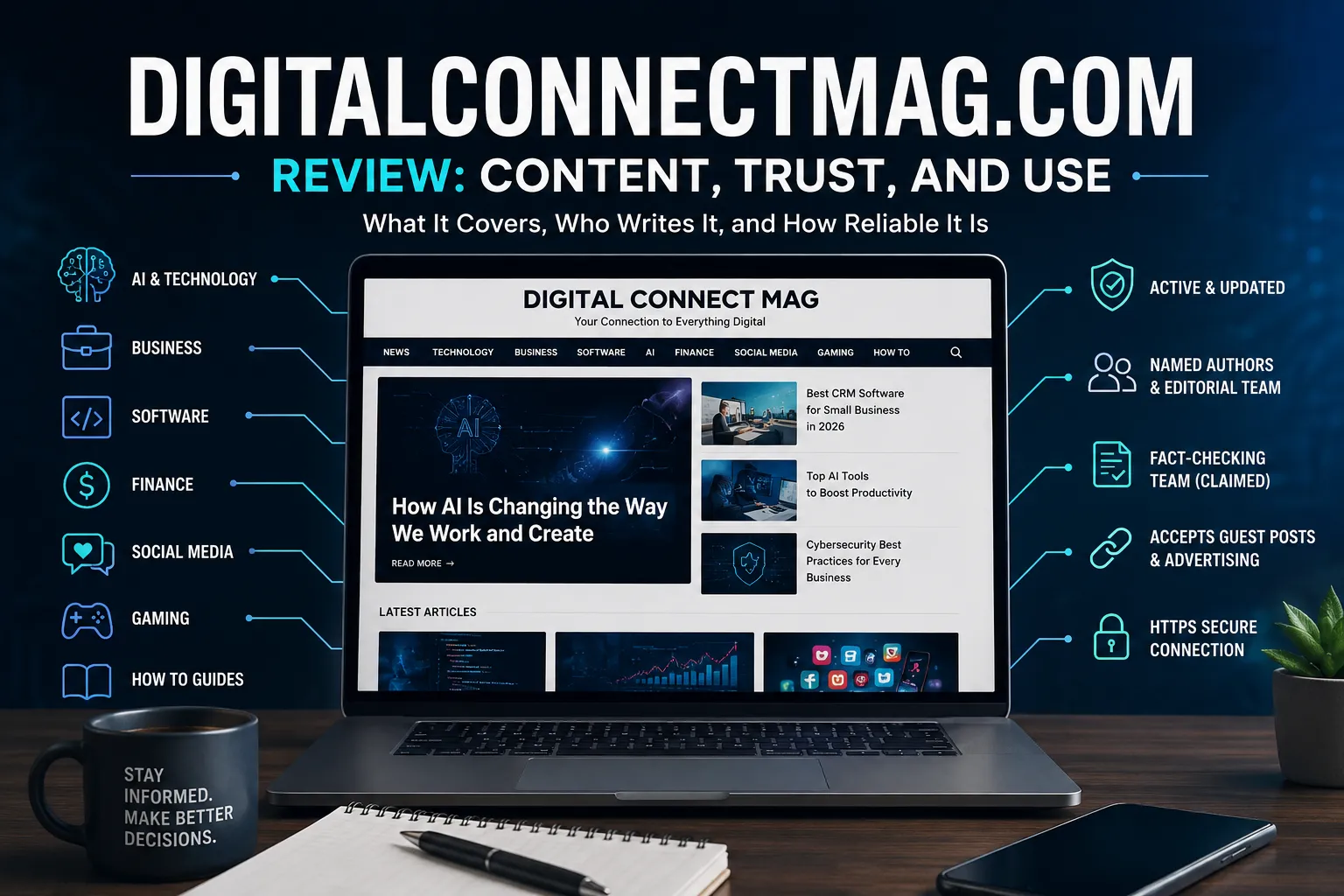
DigitalConnectMag.com is an active online publication covering technology, business, software, artificial intelligence, finance, gaming, and internet platforms. It publishes news, tutorials, product roundups, comparisons, and practical guides for readers who want an accessible introduction to a digital topic.
The site shows several public signs of an operating publication, including an active archive, named team members, author bylines, contact details, and editorial pages. That does not mean every article should be treated as equally reliable. Digital Connect Mag accepts guest contributions and advertising, and many of its subjects change quickly. The usefulness of the site therefore depends on the article, the evidence it provides, and the decision a reader plans to make.
What Is DigitalConnectMag.com?
DigitalConnectMag.com is the domain of Digital Connect Mag, an English-language online magazine focused on technology, business, and IT. It is a content publisher rather than a software vendor, online store, or official support service. Its main purpose is to publish articles that explain tools, platforms, trends, and digital services.
That distinction matters when evaluating its advice. A Digital Connect Mag article can explain what an AI editor does, compare several business applications, or introduce a privacy tool. It does not replace the official documentation, pricing page, security policy, or legal terms of the product being discussed.
The current site should also not be confused with an older publication that used a similar Digital Connect Magazine name in the early 2000s. The present review concerns the website operating at DigitalConnectMag.com.
What Topics Does Digital Connect Mag Cover?
Digital Connect Mag covers a broader range of subjects than a narrowly focused technology blog. Its current navigation includes software, apps, AI, business, finance, cryptocurrency, gaming, social media, tutorials, IP addresses, news, and collections related to streaming sites, anime, manga, torrents, and proxies.
These topics can be grouped according to the type of help a reader is seeking.
| Content area | Typical coverage | Main reader need | What may require verification |
|---|---|---|---|
| Technology and AI | AI tools, devices, automation, digital trends | Understand a tool or development | Features, limitations, privacy, and current availability |
| Software and business | Apps, CRM systems, productivity, marketing, finance tools | Compare products or improve a workflow | Pricing, integrations, contracts, and vendor claims |
| Internet platforms | Social media, streaming, websites, proxies, and online services | Learn how a platform works or find alternatives | Legality, licensing, privacy, and regional access |
| Gaming and entertainment | Games, skins, anime, manga, and streaming resources | Discover services or understand a platform | Account safety, payments, ownership, and service reputation |
The range makes the site convenient for discovery. A visitor can move from a business software guide to an AI article or gaming comparison without leaving the publication. The tradeoff is that the required standard of evidence changes from one category to another.
A simple tutorial may be useful even when it contains few external sources. A recommendation involving investments, cybersecurity, online payments, VPNs, copyrighted content, or personal data needs more careful checking.
Who Is DigitalConnectMag.com For?
The site is most useful for readers at the beginning of a research process. Its articles generally aim to make technology and internet topics understandable without requiring advanced technical knowledge.
A reader might use Digital Connect Mag to:
- learn the basic purpose of an unfamiliar application;
- identify features to compare before choosing business software;
- find an initial list of AI tools or online platforms;
- understand common terminology before reading official documentation;
- explore alternatives to a service they already use.
For example, a small-business owner researching customer relationship management software could use an article to identify common features such as contact management, automation, reporting, and integrations. The next step should be checking those features, prices, and contract terms directly with the shortlisted vendors.
The same principle applies to consumer technology. An article about AI photo editors may help a reader create a shortlist, but image ownership rules, upload limits, subscriptions, and data-handling policies should be confirmed on each product’s official website.
The articles reviewed during preparation were available without a required account or paywall. The site also offers an optional email subscription for readers who want updates.
Who Writes and Publishes the Content?
Digital Connect Mag has a public team page listing a chief editor, an editor, technical writers, a news writer, and a PR manager. Many articles also display an author byline and publication or update date. These elements provide more transparency than an anonymous content site.
The team descriptions emphasize technology, privacy, cybersecurity, and business experience. Digital Connect Mag also states on its About page that it uses a fact-checking team. However, this is the publication’s own description of its process. The public statement does not, by itself, establish that every article has undergone the same level of review.
Readers should also understand the site’s contributor model. Its Write for Us page openly accepts guest posts and blog advertising. It promotes publication as a way for outside writers and businesses to receive referral traffic and backlinks, while allowing an accepted article to include a link in its body.
Accepting contributed content is common across online publishing, and it does not automatically make an article inaccurate. It does mean that authorship, sourcing, commercial context, and disclosure should be checked at the article level. A named staff article and a contributed product feature may have different purposes and editorial inputs.
Is DigitalConnectMag.com Legit?
The word legit can refer to several different questions. A useful assessment should separate whether a site operates as a real publication, whether the connection is technically protected, and whether a particular article is accurate.
DigitalConnectMag.com shows multiple public signs of an operating publication:
- it maintains an extensive article archive;
- it was actively publishing new material in July 2026;
- it lists editorial and writing roles;
- many articles display bylines and dates;
- it provides contact, About, advertising, and contributor pages;
- it publishes a physical contact address.
Muck Rack also lists Digital Connect Mag as a verified magazine and includes recent articles from the outlet. Its profile classifies the publication as a national media outlet in the United States. The official Digital Connect Mag pages, however, list an office address in Bangkok, Thailand. These two descriptions should not be combined into an unsupported claim about where the business is legally registered or where every contributor works.
The website uses HTTPS, which protects data transmitted between a visitor’s browser and the site. HTTPS is a basic technical safeguard, not a certificate of editorial accuracy. It does not confirm that every external service mentioned in an article is safe, legal, reputable, or suitable for the reader.
The most supportable conclusion is that DigitalConnectMag.com operates as an identifiable online publication. Legitimacy at the website level does not remove the need to evaluate individual articles.
How Reliable Is the Information?
Reliability varies according to the topic, age, author, and sourcing of a specific article. Digital Connect Mag publishes across fields that change at very different speeds. A general explanation of project management may remain useful for years, while software pricing, AI capabilities, streaming domains, privacy settings, and financial products can change soon after publication.
A review of articles from different categories also shows that the amount and quality of supporting evidence are not identical throughout the site. Some materials provide clear explanations and cautious recommendations. Others include precise performance claims, product endorsements, or commercial links without showing enough primary evidence for a reader to verify the conclusion immediately.
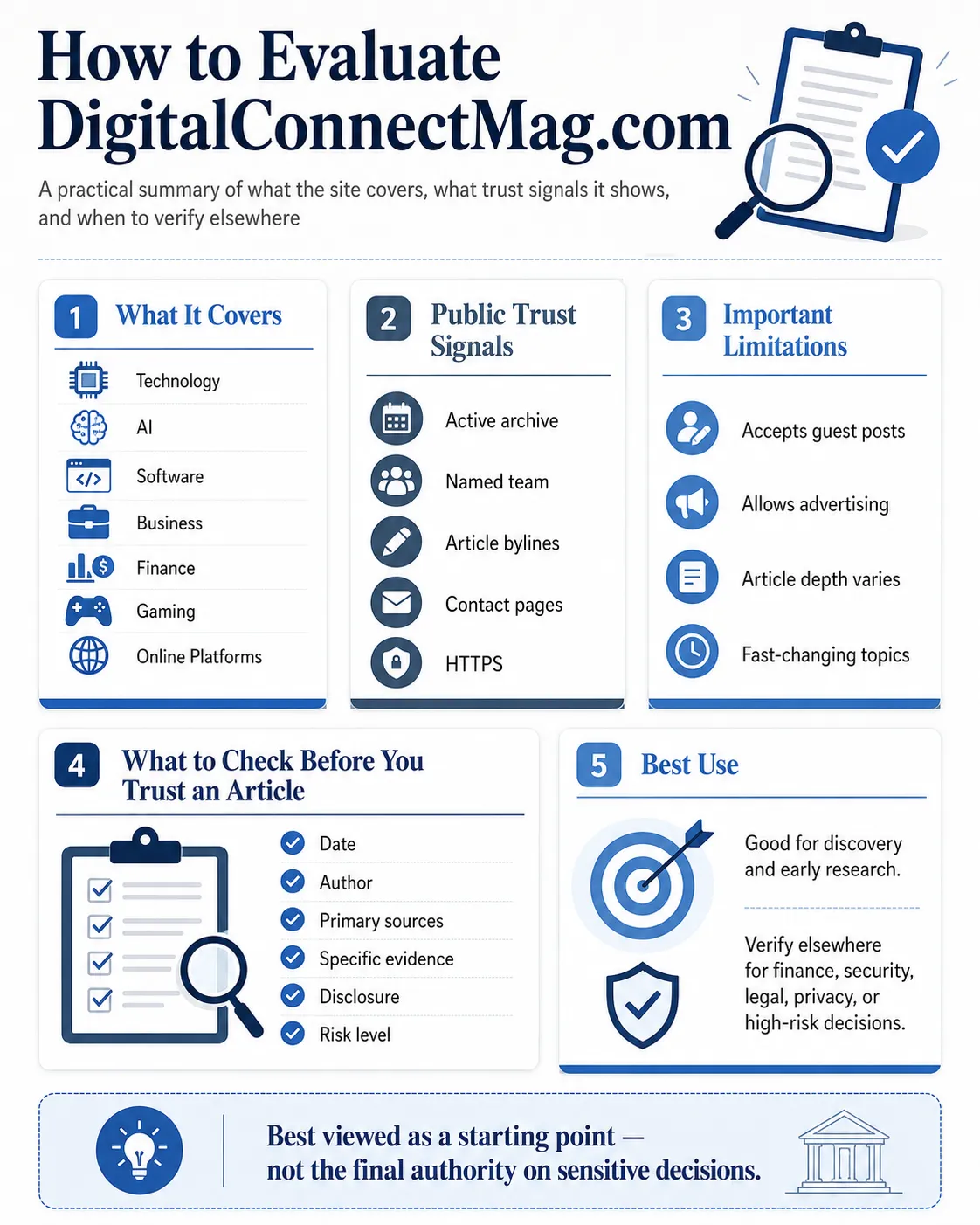
Before acting on an article, check the following signals:
- Date and update status: Confirm that the information applies to the current version of the product, platform, or policy.
- Author and context: Look for a byline and consider whether the author demonstrates relevant knowledge of the subject.
- Primary evidence: Check for links to official documentation, original research, regulatory records, company policies, or direct announcements.
- Specific support: Be cautious when exact numbers, rankings, or performance promises appear without a clear methodology.
- Commercial relationships: Look for sponsorship, affiliate, contributor, or promotional disclosure on the individual page.
- Consequences of being wrong: Apply stricter standards when the advice affects money, privacy, security, health, legal rights, or access to copyrighted material.
The absence of a disclosure does not prove that an article was paid for. At the same time, the site’s public guest-post and advertising model makes it reasonable to examine whether a product recommendation has a commercial context.
Third-party domain scores are also limited. Automated reputation services can help identify technical warning signs, but their ratings do not measure the accuracy of every statement in an editorial archive.
Strengths and Limitations
Digital Connect Mag’s clearest strength is its range. It brings together practical material on consumer technology, business systems, AI, software, gaming, privacy, and online platforms. This can save time when a reader wants an overview before beginning more focused research.
The site also offers visible editorial signals. It publishes team information, author bylines, dates, contact details, and contributor guidelines. Current publication activity makes it more useful than an abandoned archive whose product recommendations have not been maintained.
Another strength is accessibility. Much of the content is written for readers who want a direct explanation rather than specialist documentation. Tables, lists, examples, and step-by-step formats can make unfamiliar tools easier to understand.
The same broad coverage creates limitations. Expertise that is relevant to cybersecurity does not automatically transfer to finance, healthcare, legal questions, gaming marketplaces, or copyrighted media. Readers should not assume that every category receives identical editorial review.
The contributor and backlink model is another reason to inspect individual pages. A well-researched guest article can be valuable, but promotional objectives may affect topic selection, product emphasis, or the confidence of a recommendation.
Finally, many covered subjects become outdated quickly. A platform may change its pricing, ownership, domain, privacy policy, availability, or technical features after an article is published. Current official information should take priority when it conflicts with an older guide.
When DigitalConnectMag Is Useful and When to Verify Elsewhere
DigitalConnectMag.com is most useful as a discovery and orientation resource. It can help a reader understand a topic, build a shortlist, and identify questions to ask before choosing a product or service.
The amount of additional verification should match the risk of the decision.
| Reader task | Role of Digital Connect Mag | Best next source |
|---|---|---|
| Learn what a tool or concept means | Useful introductory explanation | Official documentation for current details |
| Compare several apps or services | Useful for creating a shortlist | Vendor pricing, feature, and policy pages |
| Choose a finance or security product | General background only | Regulators, audits, official policies, and specialist sources |
| Evaluate a streaming or download platform | Insufficient as the only authority | Licensing information, local law, and rights-holder sources |
| Follow a technical tutorial | Useful when steps are current | Product documentation and a verified backup plan |
For low-risk research, a recent and clearly written Digital Connect Mag article may provide enough information to decide what to investigate next. For purchases, security changes, financial decisions, sensitive data, or legally uncertain services, treat the article as one input rather than the final authority.
The practical approach is straightforward. Check the author and date, identify the evidence behind the main claim, look for commercial disclosure, and confirm important details with a primary source. Used that way, DigitalConnectMag.com can be a useful starting point without being mistaken for an official source on every subject it covers.