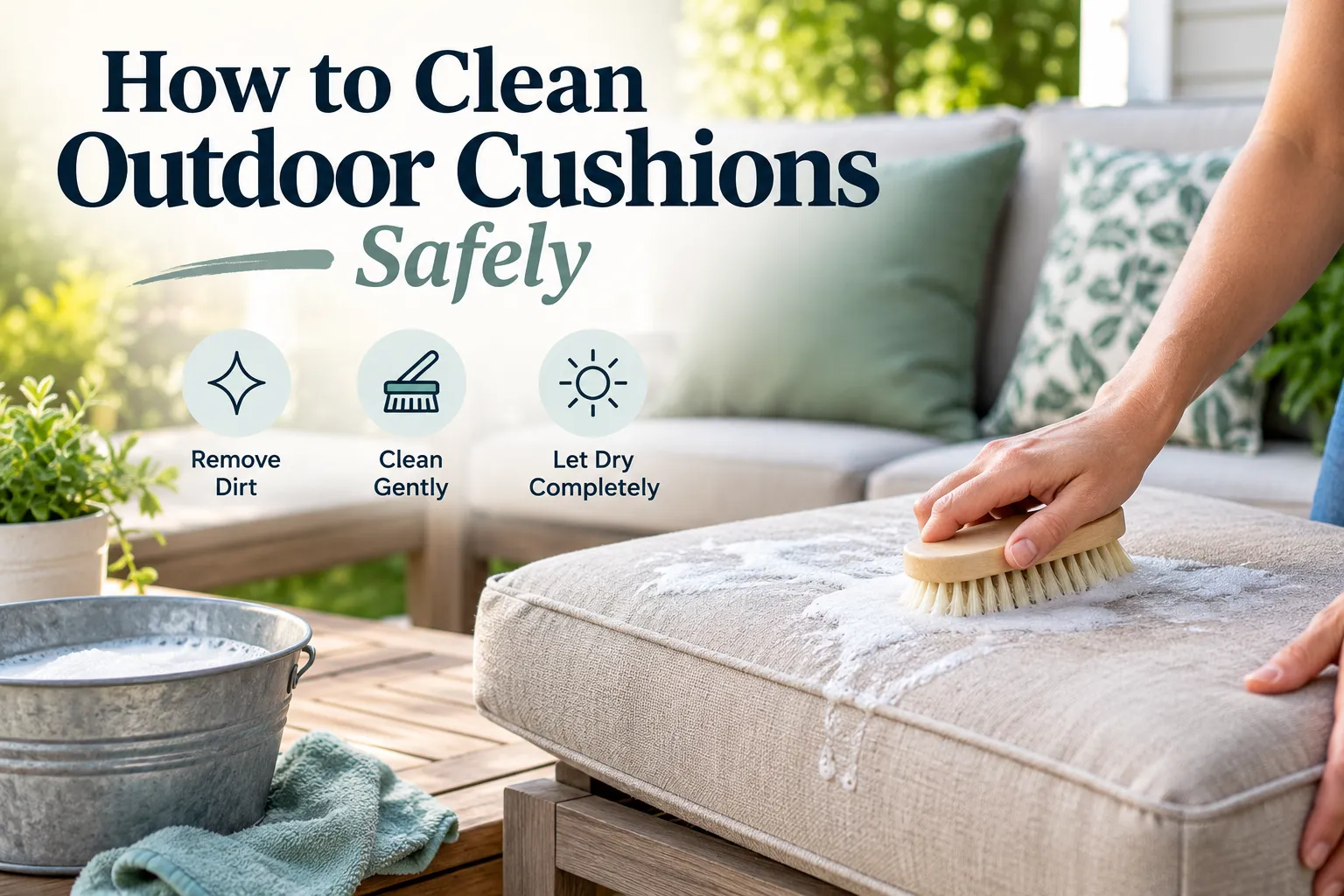
Outdoor cushions collect pollen, dust, food spills, sunscreen, and other grime throughout the season. Cleaning them is usually straightforward, but the right method depends on the fabric, the cushion construction, and the manufacturer’s care instructions.
Before adding water or detergent, check whether the cover is removable, whether machine washing is permitted, and how the cushion insert should be handled. A zipper alone does not mean a cover can safely go in the washing machine.
Check the Cushion Before Getting It Wet
Start with the care label or the furniture manufacturer’s cleaning instructions. Outdoor cushions can use different fabrics, coatings, backing materials, seams, and fillings, so a method that works for one cushion may not suit another.
Check these details before cleaning:
- whether the cover can be removed;
- whether machine washing is specifically permitted;
- whether the fabric allows bleach or another specialty cleaner;
- whether the cushion insert can be thoroughly rinsed or should be kept relatively dry.
A removable cover and a machine-washable cover are not necessarily the same thing. Some removable casings have their own hand-washing or cleaning instructions, so confirm the permitted method before putting one into a washer.
If no readable care information is available, use a conservative approach. Begin with dry debris removal and mild surface cleaning rather than experimenting with aggressive cleaners or equipment.
Also identify the problem before choosing a treatment. General dirt, an isolated food stain, and mildew-like spotting do not always require the same procedure.
Remove Dry Dirt Before You Wash
Loose debris is easier to deal with before it becomes wet. Leaves, pollen, pet hair, crumbs, and dried soil can turn into a muddy film once cleaning solution is added.
Remove the cushions from the furniture when practical. Shake them outdoors, then use a soft brush or an upholstery vacuum attachment to clean the main surfaces, seams, piping, and creases.
Avoid hard scrubbing at this stage. The goal is simply to remove particles that are already loose rather than grinding them farther into the fabric.
Check both sides of each cushion. The lower edge and back often collect dirt where the cushion rests against the furniture, even when the visible face looks relatively clean.
Once the loose material is gone, stains and heavily soiled sections become much easier to identify.
Hand-Clean Cushions That Stay in Place
Hand cleaning is the more controlled choice when the cover is fixed, machine washing is not permitted, or the care instructions specify surface cleaning.
Use the cleaner recommended for the fabric. Some outdoor upholstery can be cleaned with mild soap and water, but the permitted cleaner and concentration should come from the care instructions rather than a universal household recipe.
A practical cleaning sequence is:
- Prepare the permitted cleaner. Follow the label instead of increasing the detergent strength because the cushion looks especially dirty.
- Clean the fabric evenly. Work across the surface with a soft brush, sponge, or cloth suitable for the material. Give visibly dirty areas extra attention without aggressively grinding at one spot.
- Allow any specified contact time. If the cleaner requires time to work, follow its directions rather than using an arbitrary soaking period.
- Rinse thoroughly. Remove the cleaning solution so soap or cleaner is not left in the fabric.
- Remove excess surface water gently. Do not twist or wring the cushion unless its care instructions specifically allow it.
Pay attention to how wet the insert becomes. Some outdoor cushions are designed to tolerate thorough rinsing and drain readily, while others use construction that calls for more controlled surface cleaning.
Do not pressure-wash a cushion unless its manufacturer specifically permits that method. High-pressure cleaning should not be treated as a general shortcut for outdoor upholstery.
Wash Removable Covers Only When Allowed
A zippered cushion may appear ready for the washing machine, but removal alone does not establish how the fabric should be washed.
Before taking off the casing, check the furniture and fabric instructions. If machine washing is allowed, follow the specified cycle, water temperature, detergent, and drying method.
Keep the insert separate while the cover is being cleaned. This gives you a chance to check it for dampness, staining, deterioration, or odors that cleaning the outer fabric alone may not address.
If the cover comes off but no machine-washing directions are available, do not assume that a gentle cycle is harmless. Use the approved hand-cleaning method until you can confirm otherwise.
Do not reinstall a clean cover over a damp insert. Both parts need to be ready for reassembly according to their care requirements.
Treat Mildew and Stubborn Spots Separately
A localized stain does not automatically justify a stronger cleaner across the entire cushion. Treat unusual marks according to what caused them and what the fabric permits.
Use this quick guide to decide what needs attention:
| What you see | First decision | Do not assume |
|---|---|---|
| General dirt or pollen | Use the routine cleaning method | Stronger cleaner means better cleaning |
| Removable cover | Check washing instructions | A zipper means machine washable |
| Localized food or body-soil stain | Use the approved spot treatment | Every stain needs the same cleaner |
| Mildew or mold-like spots | Check the fabric-specific treatment | Bleach is safe for every cushion |
| Damp insert | Prioritize complete drying | A dry surface means a dry core |
Mildew or Mold-Like Spots
Mildew treatment is especially dependent on the fabric. Some outdoor performance fabrics permit a diluted bleach treatment, while other materials or finishes may not.
Use bleach only when the cushion or fabric manufacturer explicitly allows it, and follow the specified product strength, application method, rinsing, and handling instructions. Do not copy a bleach recipe intended for another brand or fabric.
Avoid mixing cleaning products in an attempt to make a stronger solution. Use one approved treatment as directed and rinse it as required before moving to another method.
After cleaning mildew-like marks, consider why the cushion stayed damp enough for the problem to develop. Stacking wet cushions, putting them into closed storage before they dry, or repeatedly leaving moisture trapped in the insert can create conditions where the problem returns.
Food, Sunscreen, and Other Spots
For an isolated stain, remove or blot excess material first so it does not spread across a larger area. Then use the spot-treatment method approved for the fabric.
Avoid aggressive scrubbing simply because a mark is old. If normal cleaning does not remove it, identify the stain type and check the fabric instructions before increasing treatment strength.
This approach limits stronger treatments to the area that actually needs them.
Dry the Fabric and Cushion Core Completely
Drying is part of the cleaning process. A cushion that feels dry on the surface may still hold moisture deeper in the filling, around seams, or along its lower edge.
Position the cushion so air can circulate and water can drain if its construction allows. The best orientation depends on the cushion design, so follow any manufacturer drying guidance rather than relying on a fixed number of hours.
Check several areas before returning the cushion to the furniture. Pay attention to:
- the bottom surface;
- seams and piping;
- corners;
- thicker padded areas;
- the insert beneath a removable cover.
Do not use a clothes dryer unless the care instructions permit it. Some removable outdoor covers require air drying even when machine washing is allowed.
If the outer fabric feels dry but the insert remains damp, continue drying. Reassembling or storing the cushion too early traps moisture exactly where airflow is poorest.
Keep Outdoor Cushions Cleaner Between Washes
Regular light maintenance can reduce how often a full wash is necessary.
Between deep cleanings:
- brush or vacuum away pollen, leaves, and loose dirt;
- deal with spills before they become older stains;
- let rain-soaked cushions dry thoroughly before stacking or storing them;
- use covers or protected storage according to the furniture manufacturer’s recommendations during extended periods of non-use.
Do not put noticeably damp cushions into a closed storage box simply to protect them from more rain. They still need enough airflow to dry before enclosed storage.
A cushion that is brushed or vacuumed regularly may need only localized stain treatment instead of another complete wash.
The most reliable approach is to let the cushion itself determine the cleaning method. Check how it is made, follow its permitted care procedure, use stronger treatments only when the fabric allows them, and make sure both the cover and the insert are dry before the cushion goes back into use.
FAQ
Can outdoor cushion covers go in the washing machine?
Only if the care label or furniture manufacturer specifically allows machine washing. A removable or zippered cover is not automatically machine washable, so check the permitted cycle, detergent, water temperature, and drying method first.
Can I use bleach to clean mold or mildew from outdoor cushions?
Bleach is appropriate only for fabrics whose manufacturer explicitly allows it. Some performance fabrics provide their own diluted-bleach instructions, but those directions should not be applied to other cushions. Follow the fabric-specific cleaning method and rinse as directed.
Can I pressure wash outdoor cushions?
Do not pressure-wash outdoor cushions unless the manufacturer specifically says the material and construction can tolerate it. High pressure may affect fabric, seams, backing, or the cushion insert, so it should not be treated as a universal cleaning method.
How can I tell when an outdoor cushion is completely dry?
Check more than the outer fabric. Feel the bottom, seams, corners, thicker padded areas, and the insert beneath a removable cover. If any part still feels damp, continue air drying before using, stacking, covering, or storing the cushion.
What should I do if an outdoor cushion has no care label?
Start conservatively. Remove dry debris first, then use only a mild cleaning method appropriate for the material while you try to locate manufacturer guidance. Avoid bleach, pressure washing, machine washing, or other aggressive treatments until you know they are permitted.