
Many bed pillows can go in a washing machine, but the safest method depends on the pillow itself. Check the care label first, identify the filling, and make sure the pillow has enough room to move in the washer before choosing a cycle.
The pillow’s care instructions and the washing machine’s cycle guide take priority over general advice. That distinction matters because a polyester-filled pillow, a down pillow, and a solid foam insert may require completely different treatment even when they look similar from the outside.
Which Pillows Can Go in the Washing Machine?
Start by checking the label attached to the pillow, not just the pillowcase or removable cover. A cover may be machine washable while the insert underneath requires another cleaning method.
The filling provides a useful starting point, but product-specific instructions still decide whether the entire pillow belongs in the washer.
| Pillow fill | What to check first | General approach |
|---|---|---|
| Polyester or fiberfill | Care label and seam condition | Many models allow machine washing |
| Down or feather | Washing and drying instructions | Many washable models require gentle handling |
| Solid memory foam | Instructions for the foam core | Do not machine-wash unless specifically permitted |
| Latex | Instructions for the latex core | Usually requires product-specific cleaning rather than a standard wash cycle |
| Shredded or specialty foam | Exact construction and label | Rules vary considerably by product |
Do not assume that every foam pillow follows the same rule. Some designs include a washable removable cover, while the core stays out of the machine. Specialty or shredded-fill pillows may have their own instructions as well.
If the care tag is missing, look for instructions from the manufacturer when the brand and model can still be identified. Guessing from texture alone is risky, particularly with foam, latex, or mixed-material constructions.
Check the Pillow and Washer Before You Start
A machine-washable label does not mean the pillow should go straight into the drum. Inspect its condition first. Weak seams and small tears can open further once the filling becomes wet and the pillow starts moving through the cycle.
Remove the pillowcase and any detachable protector, then check:
- the care instructions for the pillow itself;
- seams, zippers, and fabric for damage;
- whether a removable cover should be washed separately;
- whether the pillow fits without being compressed tightly;
- the washer manual for guidance on pillows, bedding, or bulky items.
The design and capacity of the machine matter. A front-loader, an impeller-style top-loader, and a machine with a center agitator may have different loading recommendations. Avoid forcing a large pillow around an agitator or packing the drum so tightly that the item cannot move normally.
Balance also matters during the cycle. When the washer has enough capacity, two similar pillows may distribute the load more evenly than one. For a single pillow, follow the appliance manufacturer’s instructions for balancing bulky items rather than adding unrelated laundry at random.
How to Wash Pillows in a Washing Machine
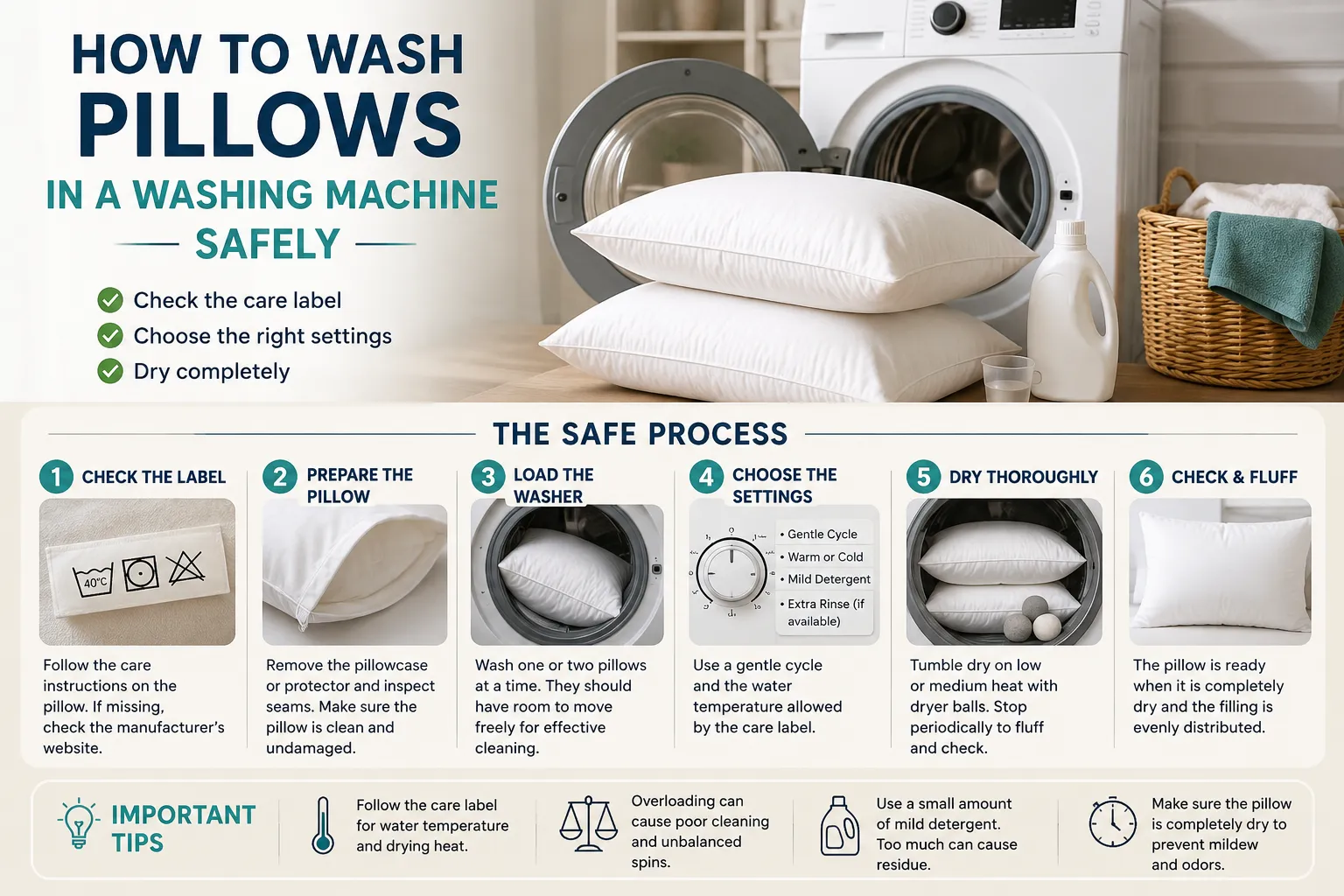
Once the pillow is confirmed as machine washable and the load fits correctly, the wash itself is straightforward. Choose the settings from the care label and washer guide instead of relying on one universal recipe.
-
Load the pillow without overpacking the drum. Leave enough space for it to move. If two similar pillows fit comfortably and the machine allows it, washing them together may help keep the load balanced.
-
Use an appropriate amount of detergent. Follow the detergent and washer directions rather than increasing the dose because the pillow is bulky. Excess detergent can be harder to rinse from thick filling.
-
Choose an approved cycle. Depending on the pillow and machine, the correct option might be labeled gentle, delicate, bedding, or bulky. Use the combination that fits both sets of care instructions.
-
Set the permitted water temperature. There is no single temperature that is right for every down, feather, polyester, or specialty pillow.
-
Use an extra rinse when useful and allowed. An additional rinse can help remove detergent from thick filling, particularly when the washer provides a dedicated extra-rinse option.
-
Remove the pillow and restore its shape gently. Avoid aggressive twisting or wringing unless the product instructions specifically permit it.
Treating a visible stain is a separate step from washing the whole pillow. Use only a pretreatment compatible with the outer fabric, and do not use bleach unless the care instructions allow it.
Dry the Pillow All the Way Through
Drying is not an afterthought. A thick pillow may feel dry on the outside while moisture remains inside the filling.
First determine whether tumble drying is permitted. If it is, use the dryer setting specified for that pillow rather than turning up the heat simply to shorten the process. Drying instructions can differ even among pillows made with similar fills.
When tumble drying is allowed, check the pillow periodically and redistribute filling that has collected in one area. Dryer balls may help separate and redistribute compatible down, feather, or synthetic fill during the cycle.
There is no useful universal drying time. Pillow thickness, fill density, dryer performance, and the selected setting all affect how long the process takes. Check several areas of the pillow, including the center. If you find remaining dampness, continue with the drying method permitted for that product.
For pillows that require air drying, follow the specified positioning and reshaping instructions. Direct high heat is not a safe shortcut unless the manufacturer explicitly allows it.
Do not return the pillow to its case, bed, or storage space until the filling is completely dry.
What Changes for Different Pillow Fills?
The basic decision process stays the same, but the filling determines which parts of the method need extra attention.
Down and Feather
Many down and feather pillows are designed to be washable, although their exact cycles and drying requirements differ. Once wet, the filling needs enough room and drying time to separate again rather than remaining in dense clumps.
If machine washing is permitted, use the approved cycle and drying method. Dryer balls can be useful for compatible products because they help redistribute the filling as the pillow tumbles.
Inspect the shell before washing. A pillow that is already losing feathers through a damaged seam should be repaired or replaced rather than put through another wash cycle.
Polyester and Fiberfill
Polyester and other synthetic-filled pillows are commonly machine washable when their labels allow it. They still should not be treated as identical products.
After washing, pay attention to how the filling has settled. If the pillow is fully dry but the fill has gathered into uneven areas, gently redistribute it when the construction allows. Avoid assuming that higher dryer heat will restore the shape faster.
Memory Foam and Latex
Solid memory foam and latex cores require a different approach. Do not put the core into the washing machine unless the manufacturer specifically says it is machine washable.
Many foam pillows have a removable outer cover with separate care instructions. In that case, wash the cover according to its label while cleaning the insert only by the method specified for the foam.
Shredded foam and hybrid pillows need individual attention because their construction varies. Some contain removable layers or washable components, while others do not. The word “foam” by itself is not enough to choose a washing method.
What If the Pillow Is Lumpy, Soapy, or Still Damp?
Check the pillow before putting the case back on. Small problems are easier to correct before the item returns to regular use.
If detergent remains in the fabric or filling, use an additional rinse when the pillow and washer instructions permit it. Adding another cleaning product will not solve detergent residue.
Clumps in a washable filling may loosen as the pillow finishes drying. Gently redistribute the material by hand or continue the approved tumble-drying process with dryer balls when appropriate.
Dampness in the center means the drying process is not finished. Continue with the permitted drying method instead of increasing the temperature beyond the approved setting.
Mechanical damage needs a different response. A split seam, broken zipper, or leaking fill is a repair problem rather than a reason to run another wash cycle.
How Often Should You Wash Bed Pillows?
There is no single washing schedule that fits every pillow. Some manufacturers recommend cleaning washable pillows about twice a year, but the right interval depends on the product, how it is used, and its care instructions.
The pillowcase and removable protector can usually be washed separately and more frequently than the insert. Keeping those outer layers clean reduces the need to put the entire pillow through unnecessary wash cycles.
Spills or visible soiling may call for cleaning sooner than a routine schedule would suggest. Before washing, return to the same first question each time: what does the care label permit?
A safe machine wash comes down to three checks. Confirm that the pillow itself is washable, make sure its filling and construction are compatible with the method, and give the item enough room in the washer. From there, use the approved cycle and finish the job by drying the filling completely before the pillow goes back into use.
FAQ
Can you wash all pillows in a washing machine?
No. Many polyester, down, and feather pillows can be machine-washed when their care labels allow it, but solid memory foam and latex cores often require a different cleaning method. Always check the instructions for the pillow itself, not only its removable cover.
Can you wash two pillows at the same time?
Yes, if both pillows fit comfortably and the washer has enough capacity. Washing two similar pillows may help balance the load. Do not pack them tightly into the drum or force them around a center agitator.
What washing machine cycle should you use for pillows?
Use the cycle permitted by the pillow’s care label and appropriate for your washer. Depending on the product and machine, this may be a gentle, delicate, bedding, or bulky-item cycle rather than one universal setting.
How do you know when a pillow is completely dry?
Check several parts of the pillow, especially the center. If any filling still feels damp, continue using the drying method allowed by the care instructions. Do not put the pillow back into its case or storage until the filling is fully dry.
How often should you wash bed pillows?
There is no single schedule for every pillow. Some manufacturers recommend washing suitable pillows about twice a year, while the appropriate interval depends on the product, how it is used, and its care instructions. Pillowcases and removable protectors can generally be washed more frequently.