
ScoopByte.com is a digital publication that mixes entertainment coverage with technology, business, lifestyle, guides, and other general-interest content. Its homepage presents the site broadly, while its About page places much more emphasis on movies, TV shows, anime, and celebrity news.
That difference is useful for anyone trying to understand the site from a single search result or article. ScoopByte is not limited to one narrow topic, and the type of content a reader encounters can vary considerably across the domain.
What Is ScoopByte.com?
ScoopByte is a content website built around articles rather than a software product, online tool, or specialized professional service. Its pages include entertainment stories, topical articles, guides, recommendations, and content about technology and business.
The site’s own descriptions do not define it in exactly the same way. The homepage says its collection explores tech, business, lifestyle, and other subjects. The About page calls ScoopByte an entertainment-focused blog dedicated to movies, TV shows, anime, and celebrity news.
Looking at both descriptions gives a more useful picture than choosing only one. Entertainment is clearly part of ScoopByte’s identity, but the wider site also publishes material outside entertainment.
The formats vary as well. The homepage includes a Best Of Lists section alongside articles categorized as news and guides centered on streaming sites, alternatives, and other online services. A reader landing on one page may therefore see ScoopByte differently from someone arriving through another subject.
What You Can Find on ScoopByte
ScoopByte’s content mix spans several areas, although they are not presented as equally important editorial verticals. Entertainment receives particularly strong emphasis on the About page, while technology, business, and lifestyle are part of the broader homepage positioning.
The site’s current pages also show guide-style content designed to help readers discover alternatives, compare services, or explore a topic. Its contributor section expands the range further by inviting submissions related to technology, business, software, artificial intelligence, and anime.
The main content areas can be summarized this way.
| Content area | What readers may encounter |
|---|---|
| Entertainment | Movies, TV shows, anime, celebrities, and streaming topics |
| Technology | Digital products, online services, and technology-related articles |
| Business | Business information, startups, and related topics |
| Guides and lists | Alternatives, recommendations, comparisons, and best-of lists |
| General interest | Lifestyle and other subjects outside the site’s entertainment focus |
Software and artificial intelligence deserve a small qualification. ScoopByte’s Write for Us page specifically lists them among accepted contributor topics, but that does not necessarily mean they function as major editorial sections throughout the current site.
This distinction helps explain why ScoopByte can appear entertainment-focused on one page and much broader on another. Its public-facing pages reflect several layers of positioning rather than one tightly defined niche.
Who Is Behind ScoopByte?
The ScoopByte About page publicly identifies three members of its team. Robbie is listed under PR and Communications, Martin as Content Editor, and Ella as News Writer. The descriptions associate Martin with writing and editing, while Ella’s profile mentions digital security, privacy, and celebrity news.
Those listings identify people associated with the site’s content and communications, but they do not provide a complete corporate ownership structure. A team page, an article byline, and ownership information answer different questions and should not be treated as interchangeable.
There is also older independent information about the site’s origins. Cybernews identified Sumit Jain as the founder of ScoopByte in a 2023 article. That supports describing him as a person who has been publicly identified as ScoopByte’s founder, but it does not establish the site’s current ownership or management structure in 2026.
ScoopByte’s current Write for Us page is also published under the name Sumit. That provides a first-party connection between the name and the site, although the page itself does not state an ownership role.
For readers, the safest interpretation is therefore straightforward. ScoopByte names a small editorial and communications team on its About page, while public references to its founder come from other sources and should not be used to infer more about current ownership than those sources actually establish.
How ScoopByte Describes Its Editorial Approach
ScoopByte maintains a public Editorial Policy that describes how the site says it selects, reviews, and presents content. The policy states that ScoopByte aims to provide balanced and accurate information and says editorial professionals are responsible for content selection, development, and maintenance.
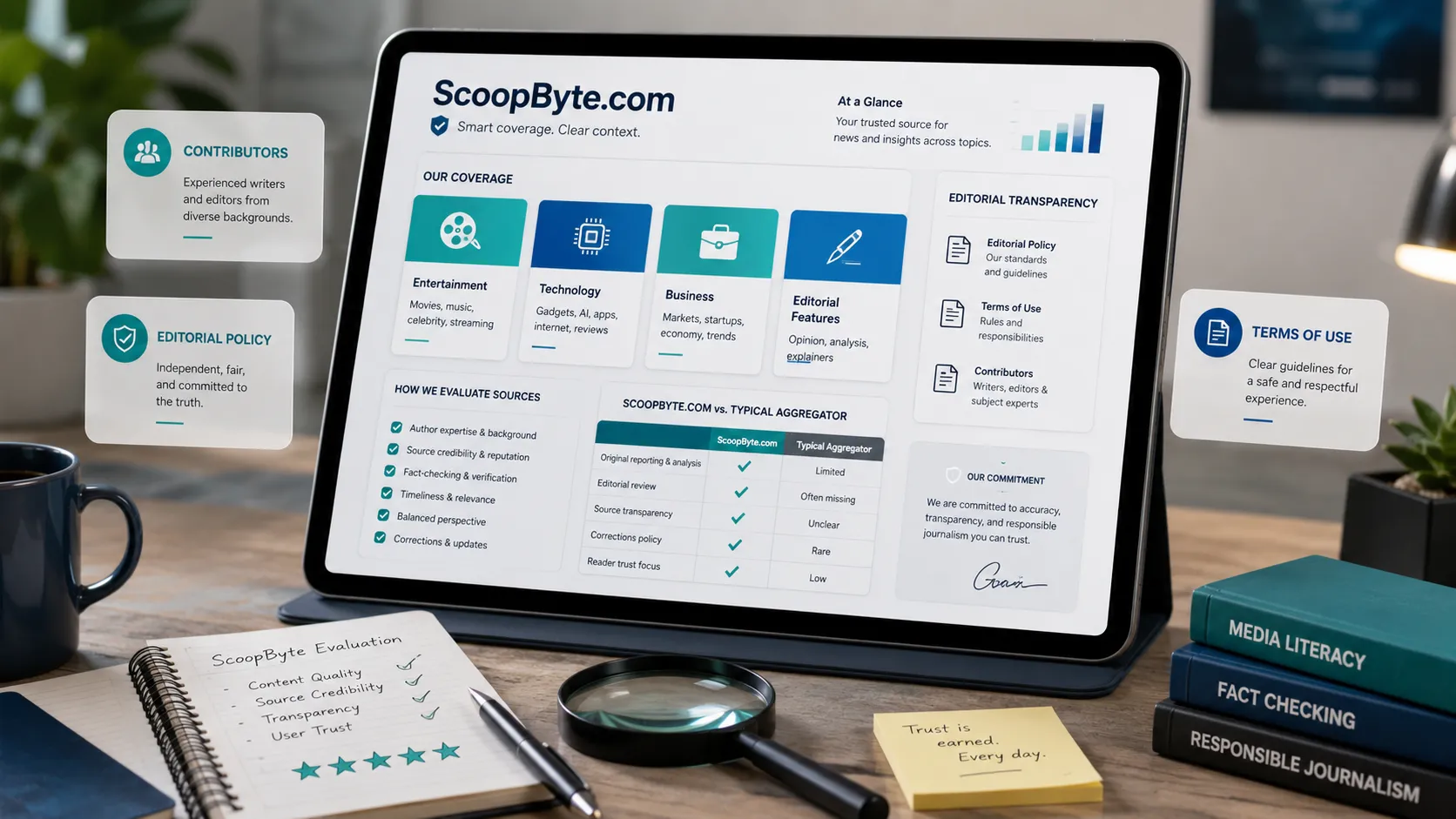
The policy also says material presented as ScoopByte’s own is created internally or obtained from content providers whose editorial processes the site has evaluated. It describes content as being written by staff writers or commissioned freelancers and says submitted material is reviewed by in-house editors.
Advertising and sponsorship are addressed separately. ScoopByte says it seeks to distinguish independent editorial content from advertising and sponsored material and acknowledges that the site relies on advertising, sponsorship, commissions, and sponsored posts.
These statements describe the standards ScoopByte says it follows. They should not be treated as independent proof that every claim in every individual article has been verified.
The site’s Terms of Use add an important qualification. In its General Disclaimer, ScoopByte says its titles are gossip sites and states that they may publish rumors and conjecture alongside accurately reported information. The same section warns that content may contain errors or inaccuracies and does not guarantee its correctness or reliability.
The Editorial Policy and Terms of Use therefore serve different purposes. One explains the editorial process ScoopByte says it aims to maintain, while the other limits what readers should assume about the accuracy of everything published on the domain.
For a reader, the practical implication is more useful than trying to reduce the entire website to a label such as reliable or unreliable. The evidence behind a particular article matters more than a general judgment about the domain.
Guest Posts and Contributions on ScoopByte
ScoopByte also invites outside writers to submit articles. Its current Write for Us page asks prospective contributors to email submissions for review and lists technology, business, software, and artificial intelligence as four primary guest-post categories. Anime is also mentioned among topics of interest earlier on the page.
The published guidelines ask for original content, research, proper structure, working links, and a minimum article length. The page says submissions are reviewed by an in-house team and that ScoopByte reserves the right to modify a submitted post before publication.
That contributor model is relevant when evaluating articles because material on one domain can originate from different types of writers. Staff-produced content, commissioned freelance work, and outside submissions do not necessarily have the same origin even when they appear within the same site design.
ScoopByte’s Editorial Policy separately says its material may be created by staff writers or commissioned freelancers and that some content can come from corporate partners. It also says areas containing partner content are designed to indicate when material has not gone through the standard editorial process.
These are ScoopByte’s stated procedures. They do not establish that every individual article is labeled in exactly the same way, so readers should use the information visible on the specific page when authorship or sponsorship matters.
How to Use ScoopByte as a Reader
ScoopByte can be useful for discovering entertainment stories, browsing guides, finding alternatives to online services, or getting an introduction to a technology or business topic. The amount of independent verification needed depends on what the article claims and what a reader plans to do with the information.
A few checks are especially useful when an article contains information that could affect a decision.
- Check the publication or update date when the subject involves software, services, prices, policies, or other information that can change.
- Distinguish a confirmed report from a rumor, recommendation, opinion, or guide.
- Follow cited sources when they are available and confirm that they actually support the article’s main claim.
- Verify consequential financial, legal, health, security, or technical information with an appropriate primary or authoritative source.
The same principle applies to recommendation and comparison content. A list of software alternatives can help identify options, but features and pricing may change. A guide to a service can provide useful context without replacing the service provider’s current documentation.
Readers should also notice where a claim originates. If a ScoopByte article summarizes an announcement, study, company statement, or government document, the original source may provide details that were shortened or omitted in the article.
This approach is not specific to ScoopByte. It is a sensible way to use any general-interest publication that combines news, entertainment, guides, recommendations, contributed articles, and commercially supported content.
What to Know Before Reading ScoopByte
ScoopByte.com is best understood as a multi-topic digital publication with a strong entertainment identity and a broader mix of technology, business, lifestyle, guides, and general-interest material. Its own pages reflect that range rather than presenting one completely consistent niche.
The site publishes an Editorial Policy describing its standards for accuracy, review, sourcing, and sponsored content. Its Terms of Use simultaneously contain a broad disclaimer covering rumors, conjecture, possible inaccuracies, and limits on the reliability readers should assume.
ScoopByte also accepts outside contributions and identifies several members of its editorial and communications team. Taken together, these details provide a clearer picture of how the publication presents itself.
For readers, the most useful approach is to judge individual ScoopByte articles by their purpose, author information, evidence, date, and sources. The domain can be a starting point for discovering a topic, while claims that are consequential or time-sensitive are better confirmed with the relevant primary source.
FAQ
What is ScoopByte.com?
ScoopByte.com is a multi-topic digital publication covering entertainment, technology, business, lifestyle, guides, and other general-interest subjects. Its About page places particular emphasis on movies, TV shows, anime, and celebrity news.
What kind of content does ScoopByte publish?
ScoopByte publishes entertainment stories, technology and business articles, guides, recommendations, comparisons, best-of lists, and content about online services. It also accepts contributed articles in areas such as technology, business, software, artificial intelligence, and anime.
Who is behind ScoopByte?
ScoopByte’s About page lists Robbie in PR and Communications, Martin as Content Editor, and Ella as News Writer. Independent publications have also identified Sumit Jain as the founder of ScoopByte, although the site’s current public pages do not provide a complete ownership structure.
Is ScoopByte.com a reliable source?
ScoopByte publishes an Editorial Policy describing standards for accuracy, review, and sponsored content. Its Terms of Use also state that the site may publish rumors and conjecture and that content can contain inaccuracies. Important or time-sensitive claims should therefore be checked against primary or authoritative sources.
Does ScoopByte accept guest posts?
Yes. ScoopByte has a Write for Us page inviting outside contributors to submit original articles for review. Listed topics include technology, business, software, artificial intelligence, and anime. Contributors should check the current submission guidelines before sending an article because requirements can change.