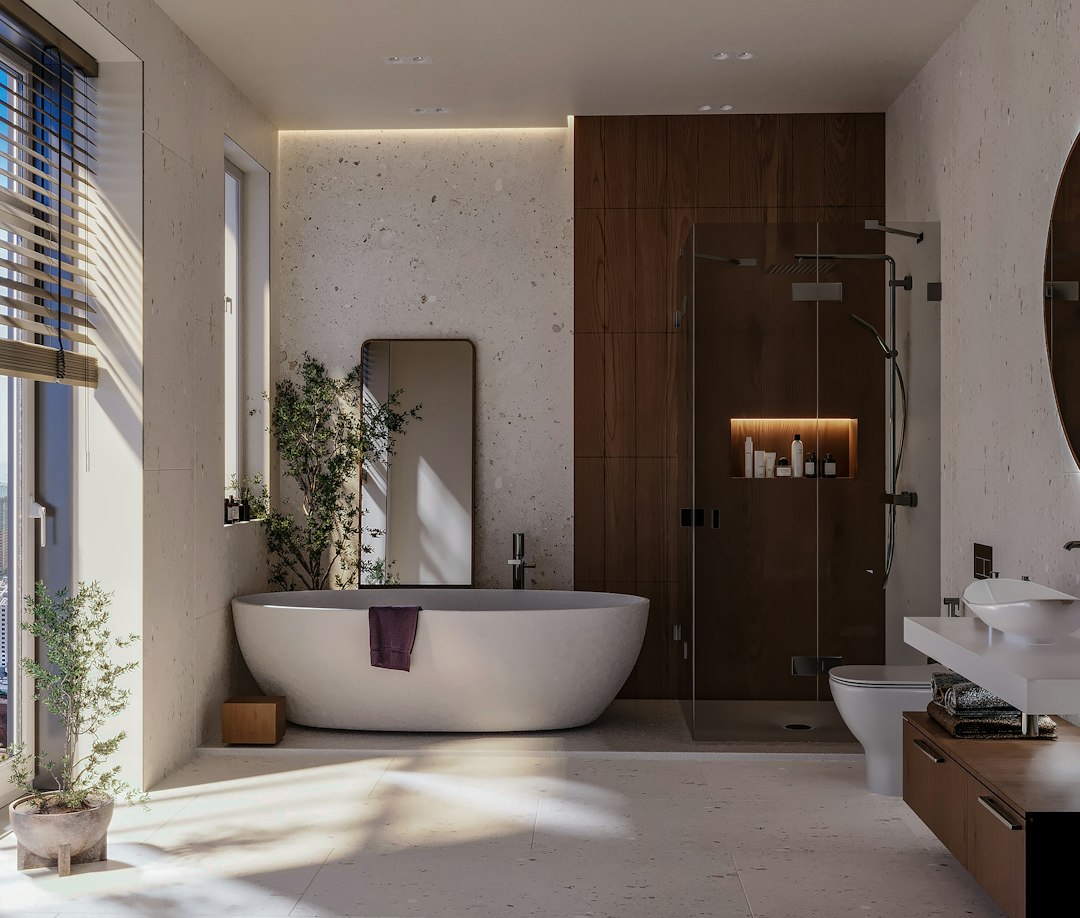
When someone describes their bathroom renovation as “gothic-aquatic,” the reasonable response is skepticism. Dark arches, deep moody color, and something vaguely oceanic — in a room where you brush your teeth at 6 a.m.? It either lands with conviction or it collapses into a Halloween store clearance. The version we’re examining here landed. Understanding why is more useful than just admiring the photos.
The space in question was a standard small-bathroom nightmare: roughly 35 to 45 square feet (verify your own footprint before planning — floors rarely lie, but memories do), grout that had gone from grout-colored to an indeterminate gray, and fixtures that weren’t failing so much as just quietly demoralizing. Nothing needed emergency replacement. Everything needed a reason to exist.
That’s actually the hardest renovation to plan. When something is broken, you fix it. When something is functional but cheerless, you have to build a vision before you swing a single tool.
Start With the Wall Surface, Not the Color
Most bathroom transformations go wrong at the same step: the owner picks a paint color from a swatch, rolls it on, and then wonders why the room still feels the same. Paint is the last decision, not the first.
In this case, the existing ceramic tile was serviceable but dated — a neutral beige that absorbed light rather than doing anything interesting with it. The renovation kept the tile footprint entirely. Instead of ripping it out (a significant cost and mess for a small bathroom, typically ranging from a few hundred dollars in materials to well over a thousand once you include waterproofing membrane, backer board, and new tile — verify current material costs locally), the approach involved grout replacement and a focused treatment on the upper wall area where tile ended and paint began.
That upper third — the painted portion above the tile line — is where the gothic-aquatic concept actually lives. A deep teal-black, roughly in the family of colors Valspar has been pushing toward with their recent blue-leaning palettes, reads differently at different times of day. Under morning task lighting it’s almost charcoal. Under a single warm-toned bulb at night it pulls distinctly green. That shift is intentional — and it’s why testing paint at actual bathroom lighting conditions matters more here than anywhere else in the house.
Apply a sample patch at 8×8 inches minimum, and check it in natural light, overhead fluorescent (if that’s what’s in the fixture currently), and whatever ambient light the room gets at its darkest hour.
The Hardware Logic Behind “Cozy” in a Wet Room
Gothic-aquatic as an aesthetic does specific things to hardware. Black matte fixtures read as gothic. Anything with an organic, irregular silhouette — a towel ring that looks slightly like a piece of wrought iron, a mirror with a beveled arch rather than a square frame — tips toward both the gothic and the vaguely maritime simultaneously.
The trick in a small bathroom is restraint. You have maybe five or six hardware elements: toilet paper holder, towel bar or ring, robe hook, mirror, faucet finish, and light fixture. Getting four of those to agree visually is enough. Forcing all six into strict coordination reads as a showroom, not a room someone uses.
Here’s a simple decision framework for small-bathroom hardware:
- Anchor pieces (mirror, light fixture): commit fully to the theme here — arch mirror, dark metal or cage-style sconce
- Functional pieces (towel bar, TP holder): match the finish to anchor pieces, but the silhouette matters less
- Plumbing fixtures (faucet, drain): matte black or oil-rubbed bronze finishes bridge gothic and aquatic without requiring you to find a “theme faucet”
- Textiles (towels, bath mat): this is where you can bring in the aquatic — deep teal, forest green, or inky navy pull the color story through without another hard surface
Lighting deserves its own sentence. A cage-style or industrial sconce at eye level on either side of the mirror does more for a moody bathroom than an overhead can light pointed straight down, which flattens every surface and makes grout lines look worse than they are. If rewiring isn’t on the table, plug-in sconces mounted with proper moisture-rated fixtures are a legitimate workaround — clip-on and plug-in light options have expanded considerably and some are rated for damp locations.
What Makes a Theme Feel Coherent Rather Than Costumed
The gothic-aquatic concept works here for a structural reason: both references share a color language. Gothic architecture leans into dark stone, deep shadow, cool grays and blacks. Aquatic interiors lean into deep water tones — navy, teal, slate, the kind of green that exists fifteen feet below the surface. Those palettes overlap almost completely. You’re not colliding two aesthetics; you’re finding their shared center.
Compare that to, say, “coastal farmhouse” — two aesthetics whose color languages (bleached driftwood and warm cream versus white shiplap and red barn accents) require active reconciliation. The gothic-aquatic combination essentially renovates itself into coherence.
That said, a theme only holds if the base conditions support it. This bathroom worked because:
- The existing tile was neutral enough not to fight the new wall color
- The ceiling was freshened — often skipped, and the single biggest giveaway of a half-committed renovation
- The grout was recolored with epoxy grout paint (a realistic DIY project in a small bathroom, though surface prep — cleaning to bare grout, not just wiping — determines whether it holds longer than one season)
- A single botanical or coral print, framed simply, introduced the aquatic reference as a specific object rather than just a color mood
That last point matters. Abstract color alone doesn’t read as “aquatic.” One deliberate reference — a vintage coral illustration, a simple kelp print, even a piece of sea glass on the vanity — cues the viewer’s brain. Then the dark walls stop reading as merely dark and start reading as underwater.
Cost-Planning for a Small Bathroom Theme Renovation
A project like this — no plumbing moves, no tile demolition, focused on paint, grout, hardware, and lighting — sits at a very different price point than a full gut renovation. That said, “small” doesn’t mean trivial. A realistic material-only breakdown to verify against current local pricing:
| Item | Rough Range to Verify |
|---|---|
| Quart of specialty paint (deep color) | $15–$30 |
| Grout colorant or epoxy paint (one bathroom) | $25–$60 |
| Arch mirror, mid-range | $80–$200 |
| Matte black hardware set (3–4 pieces) | $60–$150 |
| Cage-style sconces (pair, damp-rated) | $80–$250 |
| Framed print, single | $30–$100 |
Total material outlay could sit anywhere from roughly $300 to $800 depending on your existing conditions and what you already own. Labor, if any of this is contracted, will scale significantly — calculate the square footage of your specific bathroom first, since every foot of tile grout to be recolored adds time. Our room measurement guide touches on how to get accurate wall surface area, which is the figure you need before buying paint or grout products in quantity.
The renovation decisions that tend to blow budgets in a bathroom this size aren’t material choices — they’re scope creep decisions made after the walls come apart. Stay surface-level and you stay in control.
Where to Start This Week
Before buying a single can of paint, do two things. First, take your bathroom’s actual measurements — floor plan dimensions, ceiling height, and the height of the tile line — and note them somewhere concrete. Second, photograph the room in its current state at three moments: morning natural light, midday overhead, and evening with whatever light is currently in there. Those photos will tell you more about what the dark paint will do to the space than any swatch.
Then pick the mirror first. The mirror sets the architectural silhouette of the whole design. Once an arch mirror is on the wall, every other decision — paint color, hardware finish, what to frame above the toilet — has a reference point. Starting with paint and working toward the mirror is working backward, and it’s why a lot of moody bathroom attempts stall halfway through.