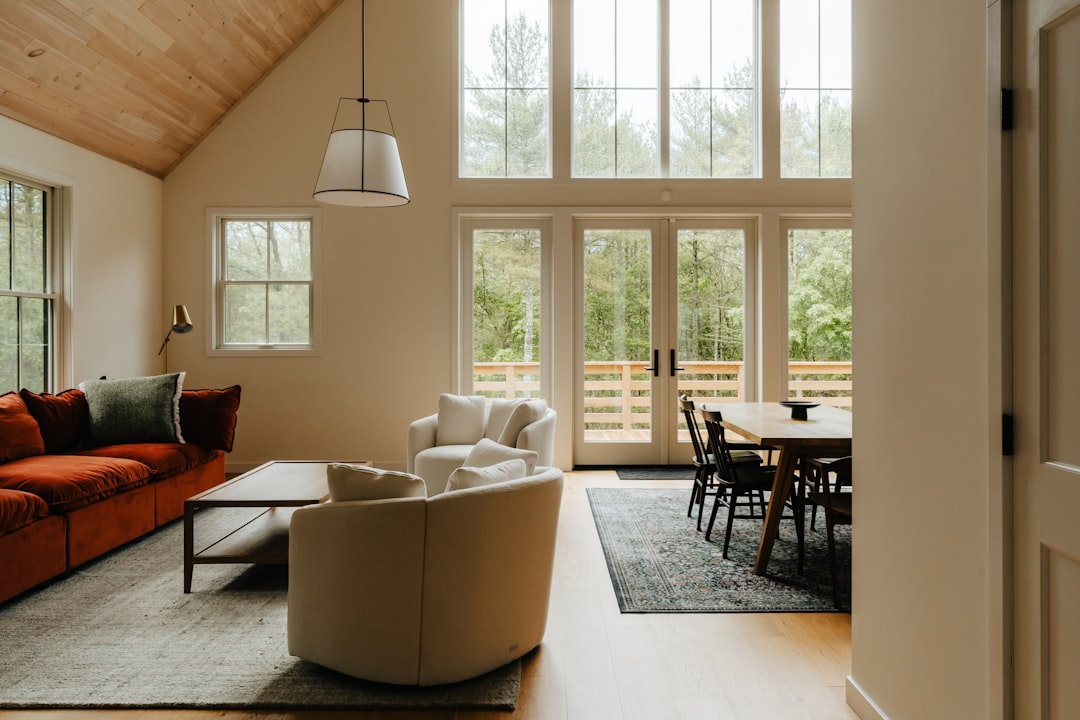
A hollow-core interior door costs somewhere between $80 and $250 installed, depending on your market and the finish you choose — and it’s one of the least interesting things you can do to a doorway. Designers working in small apartments and older homes have quietly been removing them for years, swapping in floor-to-ceiling fabric panels that billow slightly when someone walks past, and the result tends to stop people mid-tour. The trend has accumulated enough momentum now that it’s worth asking: when does a curtain actually outperform a door, and when are you just trading a practical problem for an aesthetic one?
What a Curtain Does That a Door Can’t
The functional argument is real, even if the visual case gets more attention. A hinged door requires clearance — roughly 18 to 24 inches of swing radius, depending on the door width. In a narrow hallway, a bedroom off a compact landing, or a bathroom tucked beside a staircase, that swing arc is constantly negotiating with foot traffic, furniture placement, and anyone trying to stand in the doorway having a conversation. Curtains sidestep the problem entirely. They stack to one side or the other, they can be hung so they break at the floor (adding perceived ceiling height), and they can be drawn or left open without anyone having to commit.
Sound attenuation is the honest caveat here. A solid-core door with a proper latch is always going to do more acoustical work than fabric, regardless of how heavy the curtain is. If the room in question is a home office where someone is taking calls all day, or a baby’s room adjacent to a noisy kitchen, a curtain swap is a tradeoff, not a straight upgrade. Know what you’re giving up.
For spaces where privacy is visual rather than acoustic — a reading nook, a dressing area, a walk-in closet opening, a pantry — the tradeoff mostly disappears. This is where designers have been most aggressive about the swap, and where the results look least like a compromise.
The Fabric Decision Is Where Most People Go Wrong
The instinct, understandably, is to go soft and romantic: gauze, voile, something that looks like it belongs in a Provençal farmhouse. That works in some rooms. In most American homes it reads as unfinished. The curtains that consistently look intentional rather than improvised share a few characteristics:
- Weight. Linen, cotton-linen blends, and medium-weight interlined panels hang with enough body to look deliberate. Sheer or lightweight fabric reads as a placeholder.
- Length. Floor-length, with about an inch of break at the floor, is the baseline. A curtain that hangs to 80 inches in a room with 9-foot ceilings will make the ceiling feel lower, not higher.
- Width. Each panel should be 1.5x to 2x the width of the opening it covers when drawn open. Skimping on fabric width is the detail that gives away a budget installation — the panel looks strained when closed and skimny when open.
- Hardware. A blackout rod from a discount store is going to undercut even expensive fabric. Matte black, brass, or unlacquered iron rods — as of our last check, these run from around $40 to $120 for a standard 48-to-84-inch rod — are the minimum threshold for a finished look.
Hanging height matters as much as fabric choice. Mount the rod as close to the ceiling or crown molding as the wall allows, not at the top of the door frame. That 8 to 12 inches of extra height changes the perceived scale of the entire wall.
Cost Planning: What You’re Actually Spending
Compared to door replacement, a curtain swap can be notably cheaper — or surprisingly close in cost, depending on how seriously you take the fabric. A good quality linen panel in the 96- to 108-inch length range typically runs $60 to $180 per panel, and most openings need two. Add hardware, installation anchors if you’re going into plaster or tile, and possibly a tension rod system if you can’t hit a stud, and a realistic budget for a single doorway conversion lands somewhere between $200 and $600, depending on material quality and ceiling height.
That’s not trivially cheap. But it’s reversible — no patching, no painting, no permit — which matters if you’re renting or if you’re not entirely sure you want to commit. If you’re working through a larger renovation and need to track multiple decisions like this against a total budget, it’s worth running your numbers through a cost-planning tool before committing; small per-room decisions add up faster than the line items suggest.
The comparison to door replacement is worth keeping in mind. Replacing a builder-grade hollow-core door with something better — a solid-core door with updated hardware — runs from roughly $300 to $700 or more installed, depending on your area. The curtain option isn’t always cheaper when you account for quality fabric and proper hardware, but it is faster, removable, and easier to change when your taste evolves.
Rooms Where the Swap Makes the Most Sense
Certain spatial configurations genuinely benefit from the change. Small-space living arrangements — studios, junior one-bedrooms, compact apartments — gain the most, because any square footage sacrificed to door swing is square footage that can’t hold furniture or foot traffic. A curtain separating a sleeping area from a living area in a studio does the visual work of a wall without committing to a build-out.
Older homes with non-standard door openings are another strong candidate. Pre-war construction sometimes has doorway proportions that don’t correspond to modern prehung door sizes, which means custom orders, longer lead times, and higher costs. A curtain installation, by contrast, can accommodate almost any opening width without modification.
Walk-in closets and pantries that currently have no door at all — just an open cased opening — respond well to curtain treatment. It tidies the visual field without restricting airflow or adding a swinging obstruction in a space where you’re typically standing still and reaching for things.
The spaces where we’d push back: any door that’s doing meaningful acoustic or privacy work (a bathroom with direct line-of-sight from a living room, a bedroom in a shared household), and any doorway in a home where a future buyer will expect a standard door. Renovation decisions that improve how you live in a space now while reducing its appeal to someone else later deserve a second look before you commit — particularly in a market where buyers scrutinize small details carefully.
Making It Look Like a Design Decision Rather Than a Workaround
The difference between a curtain-in-a-doorway that looks considered and one that looks like a college apartment comes down to a few steps that most people skip. First, remove the existing door casing if it’s there — or at minimum, ensure the curtain rod hardware clears it without the panel catching on the edge every time it moves. Second, steam or press the fabric before hanging; a wrinkled linen panel suggests it came out of a shopping bag that morning. Third, consider blackout lining if the room behind the curtain has a window and you don’t want light bleed to signal the division.
For a more permanent installation in a room you’re keeping long-term, ceiling-mounted tracks — the kind used in hospital curtain systems, now available in residential versions — provide smoother operation and a cleaner look than any rod-and-ring system. They require a bit more installation effort and run higher in cost (verify current pricing with hardware vendors, as availability varies), but the result is a curtain that moves like it was designed for the space rather than retrofitted into it.
The builder-grade instinct — to go with the cheapest option that technically fulfills the function — is the one to resist here. A curtain done at low cost looks like exactly that. Done with appropriate fabric weight, proper hanging height, and hardware that doesn’t wobble, it looks like a deliberate architectural gesture. The gap between those two outcomes is mostly decisions, not dollars.
Start with a single doorway — ideally one where the existing door is already problematic (sticks, swings into furniture, never gets closed anyway) — and live with a fabric panel for a few weeks before committing to a wider swap. Buy a half-yard of your shortlisted fabric first and hang it in the space to check how the color reads in your actual light, not in a showroom or a product photo. That small test step saves more renovation regret than almost anything else on a project like this.